
Beginner’s Guide to Fish Keeping and Building your first Aquarium (Part 2)

Aquascaping
This topic is a big topic and should be a separate Blog post, but here is a short description and a few tips.
Aquascaping is a combination of Artist and Science put together to form a beautiful showcase environment for your aquarium. Not everyone will be interested or know how to build a master piece like those famous Japanese Aquarists (see YouTube for japanese aquascaping to see what I mean) but you can do some fundamental building decisions that will decide how your tank areas will be mapped out.
This has several benefits of making your tank look esthetically pleasing but also taking into consideration of your fish and their character behaviour’s. For example, Do you fish like to hide and have sanctuary most of the time ? Do they typically swim a lot back and forth to get exercise ? What part of your tank do they frequent (Top, middle, bottom, substrate) ? Do you have cave dwellers or fish who love long weeds. Does your design incorporate dark areas as well as lighter areas. Do you have a river-like water current flow in your tank or is it a subtle stream.
These answers will add to your design to make sure you incorporate things that you fish you choose to put in your tank will benefit from as well as being esthetically pleasing.
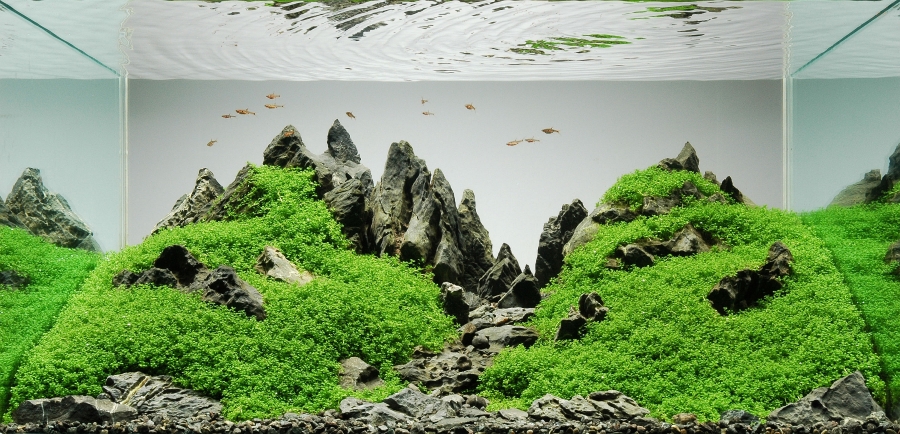
This Aquascape Example (source = Wikipedia)
General Design considerations:
- Design your tank with Light and dark areas
- For Rectangular Tanks, try to keep larger plants in the back and shorter plants in the front
- Make sure to have your equipment set up so that one end of the tank is getting fresh water and your other end is sucking in the bad water, this creates a flow and lessens dead spots.
- Accent flow with water bubblers (air stones) and air pump
- For more water circulation use an in tank circulation and wave pump powerhead. Hydor is one manufacturer.
Here’s a video on one such pump
https://www.youtube.com/watch?v=6PtwdO1B6e4 - Give your fish some hiding areas as well as some open areas for swimming.
- Don’t crowd your tank too much with ornaments or decorations that are hard to clean or remove for cleaning. Fish can get trapped inside some ornaments as well so be careful.
- Make sure enough lighting can get to the areas it needs to. Although not as important in freshwater tanks, it is critical in marine or salt ware tanks. For fresh water this adds more light and dynamic effects.
- Use natural products in your tank where possible. Live Rock is a very good addition to your tank and you can create a structure from gluing (with aquarium silicone – at your local Fish store) pieces together
- Do not use any kind of non-aquarium safe glue, metal, plastics or other materials. Pure Acrylic paints that are fully cured and sealed with an acrylic clear coat without any VOC’s left in it should be safe for aquariums. Check all labels and contact manufacturers if unsure.
- Plastics that are known to be safe are any food safe plastics, acrylic and pure or aquarium safe silicone adhesive or sealant. PVC, HDPE and Poly propylene (PP) appear to be safe as well as most of those are used in food safe products however they must be safe for food use or can withstand chemical breakdown as you do not want your plastic leaching chemicals into your tank.
- Design your equipment layout so that you can relatively easily repair or replace a broken air line, heater, etc. Suction cups are known to wear out and will need to be replaced over time for things like holding air hoses or thermometers.
- Use your space in your tank symmetrically where possible, for example if your tank is a rectangle, make good use of the space at both ends or just the middle and mostly horizontally. If you have a hex tank, try to come up with a solution that uses the back and middle of your tank (showing the front all the way around) and work up vertically to take advantage of the tanks natural height.
- Also, the most important is to design and play with your tank before filling it with water and adding fish. Nothing stresses fish out like a huge human hand moving heavy rocks and water around. 😉


